




 Case studies
 How Cross Industry Dynamics Turned a Video Game Dragon Into an 8.5-Foot Trade Show Centerpiece with robotic LFAM

September 2026
How Cross Industry Dynamics Turned a Video Game Dragon Into an 8.5-Foot Trade Show Centerpiece with robotic LFAM
September 2026

When Dire Wolf Digital needed the dragon from their game CLANK! to exist in the real world, they brought the challenge to Cross Industry Dynamics (CID). The result: a fully assembled 8.5-foot sculpture, built through Caracol’s robotic LFAM technology for a trade show floor, where a screen-only character finally became something people could stand next to.
From Pixels to a Prop That Ships in a Truck
A game asset and a physical object share almost nothing except their geometry. Dire Wolf handed CID the original 3D model, but a mesh authored for a rendering engine carries none of the structural, tolerance, or assembly data an eight-foot physical build requires.
Before production, CID ran a full design-for-manufacturing (DFAM) pass: locking scale, resolving print orientation, and segmenting the geometry into printable sections. The controlling constraint was handling, since a crew of one or two had to assemble and break down the dragon on-site without a forklift or rigging team. CID partitioned the sculpture into six primary sections sized for manual transport and mating, isolating higher-risk features like the horns as discrete components to simplify deposition and protect fragile geometry in transit.
The Production Side: Robotic LFAM and a Foam-and-Dowel Skeleton
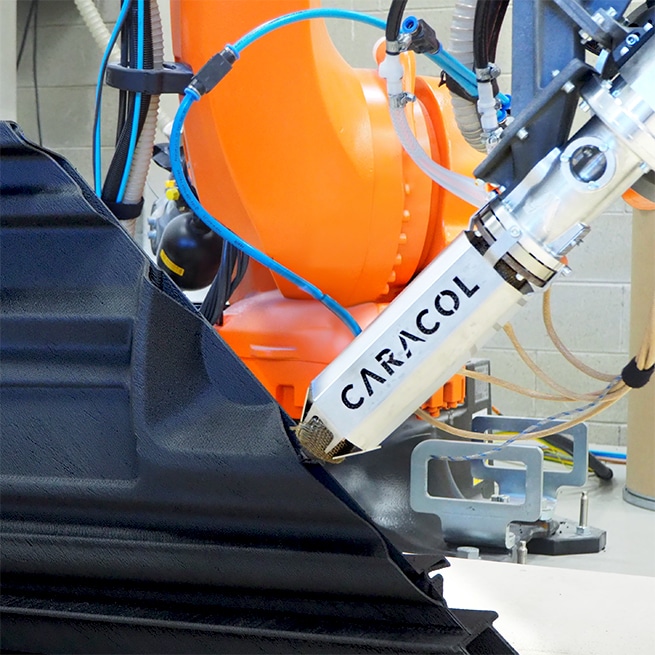
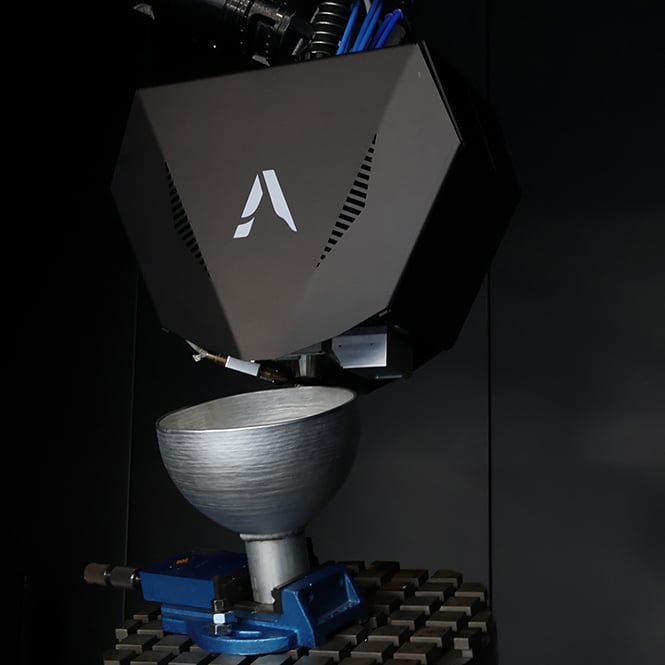
With the model production-ready, the work moved to the Caracol Heron AM platform installed and running at CID’s facility. Glass-fiber-reinforced PETG provided the structural backbone, extruded through a wide nozzle tuned to balance deposition rate against surface fidelity. Broad organic forms translated cleanly to large-format deposition, while the extreme overhangs drove the orientation and segmentation strategy, since part orientation at this scale governs surface finish, support requirements, and post-processing load.
Core production specs:
- Platform: Heron AM 300 – HV extruders
- Material: PETG + 30% GF
- Nozzle size: 5 mm
- Dimensions: 1643 × 2895 × 1402 mm
- Weight: 65 kg
- Print time: 1 week
- Parts printed: 6
Repeatable registration across rebuilds was the second constraint. CID filled the printed shells with ultra-dense marine foam and integrated a metal dowel alignment system, giving each section a defined datum so it seats into position on every installation. That repeatability, enabled by the automation inherent to the print process, let CID fold transport, teardown, and reinstallation into the manufacturing plan from the outset. For projects in the entertainment sector, where the same asset travels from show to show, that kind of repeatable assembly is often as critical as the visual result itself.
Measured against the mold-making, tooling, and hand-sculpting a one-off of this scale would traditionally require, the additive route delivered:
- Lead time reduction of roughly 55%
- Production cost reduction of around 40%, driven by material efficiency and eliminated tooling
- Weight reduction of nearly 60%, thanks to the hollow, foam-cored construction that keeps the piece manageable for a two-person crew

What It Opens Up Next
The finished dragon anchored Dire Wolf’s trade show presence and drew exactly the reaction they were after. For CID, the more significant takeaway sits underneath the sculpture itself. Robotic LFAM lets a team move directly from a digital creative asset to an architectural-scale physical object, sidestepping most of the molds, tooling, and labor-intensive fabrication that one-off work traditionally drags along.
A capable robotic advanced manufacturing platform like the Heron AM, paired with its built-in automation, is what made that path viable, turning a game character into a shippable, reassemblable, show-ready build.
And that reaches well beyond a single dragon. Across the entertainment industry – themed entertainment, experiential marketing, oversized props, branded installations, custom sculptural work, all of it is now within reach, and the method behind this project points toward a decidedly more efficient and sustainable direction.
Ready to build your next entertainment installation?
LFAM FOR THE AUTOMOTIVE INDUSTRY
Discover how to use Caracol’s large-scale 3D printing technology for your automotive applications. Register here to download the whitepaper.
Related Case Studies
Check out our success stories
-

Case studies. The Microfactory Behind Justin Bieber’s SKYLRK Seating at Coachella 2026
-

Case studies. From sketch to show floor: how Cross Industry Dynamics delivered a custom hypercar prototype in just two weeks
-

Case studies. Client Talks with ITS for Sustainable Mobility and Aerospace/Mechatronics | Robotic LFAM for Education
-

Case studies. Duondolo: when robotic LFAM sets creativity freedom
-
Case studies. AeGiS: the urban architecture revolution powered by robotic LFAM
-
Case studies. Eligio Re Fraschini explores the future of aerospace tooling with robotic metal AM
-

Case studies. NP Aerospace produces Mastiff suspension & differential carrier with Caracol’s Vipra AM technology
-

Case studies. Client Talks with Formes et Volumes | Robotic LFAM for Jigs and Molds
-

Case studies. Formes et Volumes chose robotic LFAM to produce composite lamination tools for aerospace
-

Case studies. Client Talks with Ferretti Group | robotic LFAM for custom luxury yachts
-
Case studies. From digital to track: mold-free sports car roof powered by robotic LFAM technology
-

Case studies. Client Talks with V2 Group | Robotic LFAM for Custom Marine Applications
-

Case studies. From tooling-driven constraints to robotic LFAM: engineering the next generation of marine stern structures
-

Case studies. A new era of custom luxury yachts, powered by robotic LFAM
-

Case studies. “among-all” by Patricia Urquiola turns LFAM imperfection into design intent
-

Case studies. Proto21 leveraged Heron AM to 3D print a full-scale Seaglider mockup for REGENT Craft in UAE
-
Case studies. Caracol’s LFAM technology drives the production of a Next-Generation Stratospheric Gondola
-

Case studies. JOME Engineering unlocked metal additive production of sampling valves with Vipra AM
-
Case studies. THE CAB – The first 3D-printed RV made from recycled polymer
-

Case studies. Ono Chair – the harmony of the whole with 3D printing
-

Case studies. DeltaPrint3D innovate the retail design sector with 3D printed rock textured columns
-

Case studies. Recarlo leverages LFAM in redefining its luxury retail experience
-

Case studies. Optimizing custom Legend Car bodywork production with Heron AM – Castelletto Circuit
-

Case studies. World’s Largest 3D Printed Architectural Structure built in Dubai by Proto21 with Heron AM
-

Case studies. LFAM redefines construction industry, starting with custom column formwork
-

Case studies. AM Unique transforms the desert into a Design Hub: furniture manufacturing with Heron AM
-

Case studies. Reimagining construction: advanced robotic LFAM at Biennale Architettura 2025
-

Case studies. PORTAL – A new era of furniture powered by Advanced Manufacturing
-

Case studies. Sangiorgio Marine redefines yacht superstructures production with LFAM
-

Case studies. Applying robotic LFAM in the production of Pershing GTX116 aerodynamic grilles
-

Case studies. Duqueine Automotive Set New Standards in Racing Car Development
-
Case studies. The first functional monolithic catamaran additively produced with V2 Group
-

Case studies. Gosper lamp: leveraging robotic LFAM technology to create stunning lighting design
-

Case studies. Stacked modules: 3D printing meets craftsmanship to redefine furniture production
-

Case studies. Alstom redefines the production of simulator driver desks with LFAM
-

Case studies. 3D-printed 1:5 nose mock-up for Alstom
-
Case studies. Shaping the manufacturing of industrial tooling with large format 3D printing
-
Case studies. Custom Conveyor Screw for Industrial Machinery
-
Case studies. Multi-Material Neck Flange for the Oil & Gas Industry
-
Case studies. Vipra AM in Marine Propeller Manufacturing
-
Case studies. High-Precision Autoclave Cure Tools for Aerospace
-

Case studies. 3D printing piping for the energy industry
-

Case studies. The first 3D printed ISO certified marine gangway
-
Case studies. Robotic 3D printing of custom design furniture
-

Case studies. Van Venrooy and Caracol 3D print end-parts for automotive custom vehicles
-

Case studies. Bringing LFAM to industrial production for advanced applications in the automotive sector
-

Case studies. LFAM aerospace composite parts fly high with 3D printed autoclave molds
-
Case studies. How large 3D printed mock-ups can accelerate the automotive industry
-

Case studies. 3D printed tools for aircraft manufacturing
-

Case studies. Caracol working to bridge the gap on sustainable manufacturing
-

Case studies. Pressurized Tanks for Space with WAAM
-

Case studies. 3D printed autoclave cure tooling for the automotive industry
-

Case studies. Wind Blades’ Lamination Tooling
-

Case studies. 3D printed sailboat hull with recycled materials
-

Case studies. 3D printed interiors for a luxury architectural landmark
-

Case studies. Large-scale 3D printed totem for Yamamay HQ
-

Case studies. Valentino Rossi gets giant 3D printed helmet from Caracol AM
-

Case studies. Upcycling and large-format 3D printing for sustainable architecture
-

Case studies. The first fully 3D printed robotic bar installation