




 Knowledge Hub
 Robotic automation in manufacturing: how industrial robots are reshaping modern production

June 2026
Robotic automation in manufacturing: how industrial robots are reshaping modern production
June 2026

There’s a moment, walking through a modern production facility, when it becomes clear something has fundamentally changed. The floor doesn’t hum with the same rhythm it used to. Movements are precise, relentless, unhurried. Industrial robotics arrived steadily, over decades, and now it’s everywhere, handling everything from welding and painting to inspection and large-format printing. Robotic automation has already made its place in industrial environments, the only open question is “how deep is it going to go?”.
From assembly lines to intelligent systems: the real meaning of robotic automation
What is robotic automation, exactly? The short answer: the use of programmable machines to carry out tasks that would otherwise require human operators. But that definition barely scratches the surface. In practice, robotic automation in manufacturing spans a wide spectrum: from a single articulated arm doing repetitive pick-and-place operations on an assembly line, to fully integrated systems where multiple robots, sensors, conveyors, and software platforms work in concert without a person touching the product at any stage.
The core idea is fairly simple: you design a process, encode it into the robot’s control system, and the machine executes it with a consistency no human hand can match. What makes it powerful is combining that consistency with flexibility — modern robotic systems read sensor data, adjust trajectories in real time, and flag anomalies before they become defects. They’re nodes in a larger network, connected to PLCs, ERP platforms, quality control systems, digital twins, with the intelligence distributed across the entire production architecture.
What industrial robotics really means, and where it fits in the automation landscape
If you look up an industrial robot definition in a technical standard, you’ll find something like: a reprogrammable, multifunctional manipulator designed to move material, parts, tools, or specialized devices through variable programmed motions. Accurate, but incomplete. What is industrial robotics in broader terms? It’s the discipline of making physical automation reliable, safe, and economically viable at scale, covering the mechanical engineering of robot arms and end-effectors, the control systems that govern motion, the software that monitors performance, and the integration work that ties all of it to real production environments.
Industrial automation is the wider category within which robotics sits. It covers any use of control systems — mechanical, electronic, software-based — to run industrial processes with reduced human intervention: conveyor systems, PLCs, CNC machines, automated guided vehicles, vision systems. Understanding industrial automation and robotics as a unified field, rather than treating them separately, is what leads to effective manufacturing systems. A robot operating in isolation is just an expensive machine doing one thing well. Connected to a broader architecture, it becomes part of something that responds dynamically to demand changes, detects quality issues in real time, and optimizes its own throughput.
The fields of application of industrial robots are broader than most assume. Automotive welding and food packaging get the attention, but industrial robots are equally present in aerospace composite layup, pharmaceutical cleanrooms, large-format additive manufacturing, construction prefabrication, energy infrastructure. What are industrial robots used for, ultimately? Anything where automation delivers better outcomes than human labor alone — in speed, precision, safety, or consistency — and increasingly, that covers almost every sector that makes physical things.
Large-format additive manufacturing and robotic integration
One of the more striking developments in recent years is the convergence of robotics with large-format additive manufacturing. Traditional 3D printing scaled up, using industrial robots as motion platforms instead of gantry systems, opens up a different class of manufacturing capability. Robot arms can reach around complex geometries, change orientation mid-print, and operate on workpieces that would exceed the envelope of any conventional printer.
On the polymer side, LFAM systems typically work with thermoplastic pellets, depositing material at rates that make them viable for structural parts, tooling, molds, and large-scale finished parts. Caracol’s Heron AM platform follows this architecture, using multi-axis robotic systems to produce large monolithic parts that couldn’t be manufactured any other way at industrial volumes, by eliminating the joints, assembly steps, and structural weak points that come with multi-piece fabrication.
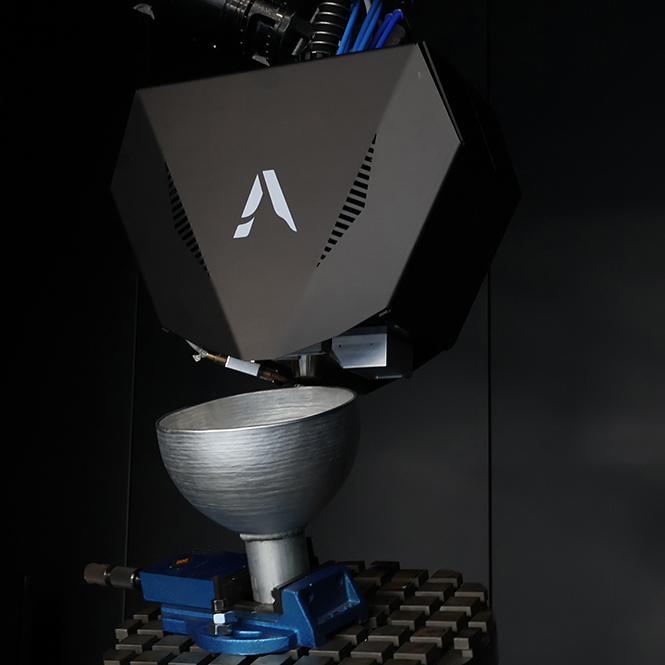
Metal additive manufacturing tells a parallel story. Wire Arc Additive Manufacturing (WAAM) uses robotic platforms to deposit metal through welding-derived processes, building up large structural components layer by layer with significantly less material waste than machining from solid billet. Caracol’s Vipra system applies this approach to industrial-scale metal parts, combining robotic deposition with the kind of process control that aerospace and energy applications demand.
In both cases, printing is only part of the story.
The raw output usually needs further treatment. Surface finish, dimensional accuracy, structural integrity: these require post-processing steps, and increasingly those steps are robotic too. Milling, grinding, polishing, NDT inspection can all be integrated into the same robotic cell or handed off to adjacent stations in a coordinated sequence. The robot that printed the part and the robot that finishes it may be different machines, but they’re operating within the same control architecture.
Print, machine, repeat: the case for hybrid robotic manufacturing
The concept of hybrid manufacturing, combining additive and subtractive processes in a single workflow, represents one of the more productive recent convergences in industrial robotics. The logic is straightforward: additive processes are good at building complex near-net-shape geometries quickly, but their surface quality and dimensional tolerances often fall short of engineering specs. CNC machining is precise but slow and wasteful on complex forms. Put them together and you get something more capable than either alone.
In practice, hybrid robotic systems can be configured in several ways. In the most integrated configurations, the same robot handles both operations – switching between an extrusion head and a milling spindle within the same cell, alternating deposition and machining passes on the same part without ever moving it to a different station. Others are sequential, passing the printed component to a dedicated CNC machine for finishing. The more tightly integrated the control, the more you can exploit the strengths of each process at the right moment.
This approach is particularly powerful for tooling and mold production, where you need structural bulk combined with tight tolerances on functional surfaces. It’s also gaining traction in aerospace and defense, sectors where component geometries are complex, material removal from solid billet would be prohibitively expensive, and a significant share of production involves custom parts in small batches that don’t justify the tooling investment of traditional manufacturing.
Smaller, smarter, closer: what the microfactory model changes
Build a large enough facility, install enough robots, run enough volume, and the economics work. That model isn’t disappearing – but geopolitical instability, supply chain disruptions, and rising tariffs are exposing its fragility. The further a part travels before it reaches the end market, the more risk it carries.
That’s the context in which the microfactory concept is gaining traction – and where industrial automation and robotics shift from operational to strategic. The idea is straightforward: compact, highly automated production environments distributed across different locations, closer to end markets, but interconnected through shared software platforms that keep production data, quality standards, and process parameters aligned across the network. Flexible industrial robot systems, hybrid manufacturing workflows, software-driven reconfiguration that can pivot between product types without weeks of engineering work. The robot isn’t just a productivity tool here – it’s what makes the entire distributed model viable.
Large-format additive manufacturing fits naturally into this architecture. It requires no molds or dies, handles complex geometries without dedicated tooling, and scales down to small batches without losing efficiency – exactly what distributed, high-mix production demands. Whether microfactories will fully displace centralized mass production in any given sector is an open question. As a complement to it, with robotic automation at the core, they’re already proving their value.
Upgrade your production line with Caracol’s large-format robotic technology.
LFAM FOR THE AUTOMOTIVE INDUSTRY
Discover how to use Caracol’s large-scale 3D printing technology for your automotive applications. Register here to download the whitepaper.
Related Knowledge Hub
Read more on our LFAM insights
-
Knowledge Hub. Is 3D Printing Environmentally Friendly? An Industrial View
-

Knowledge Hub. Direct Energy Deposition (DED): What It Is and How It Works
-

Knowledge Hub. 3D printing car in additive manufacturing: how the automotive industry is rethinking production
-

Knowledge Hub. Robotic LFAM for end-use parts in the transportation industry
-

Knowledge Hub. What Is Rapid Prototyping in 3D Printing? Methods, Examples, and Where Prototyping Ends
-

Knowledge Hub. Why the advantages of robotics in manufacturing start in the classroom
-

Knowledge Hub. 3D printing in defense: how robotic LFAM and WAAM are redefining industrial dual-use production
-

Knowledge Hub. How to build a robotic LFAM Microfactory – the final tutorial
-

Knowledge Hub. The microfactory model: robotic additive manufacturing for flexible industrial production
-

Knowledge Hub. Metal 3d printing: challenges & scalability
-

Knowledge Hub. Industry 5.0 vs Industry 4.0: key differences and what changes for manufacturing
-

Knowledge Hub. On-demand manufacturing: what it is, how it works, and some examples
-

Knowledge Hub. How Is 3D Printing Transforming Architectural Design?
-

Knowledge Hub. Carbon Fiber Composite Manufacturing at Scale: How Robotic LFAM Redefines Composites
-

Knowledge Hub. What 3D Printer Design Software to Use for Large Format Robotic Systems: A Complete Guide
-

Knowledge Hub. 3D Printing in Automotive Manufacturing, Aviation, and Mass Production: How AM Is Reshaping Mobility
-

Knowledge Hub. Best practices for Design & Production with robotic LFAM
-

Knowledge Hub. Integrating robotic process automation (RPA) for strategic growth in modern advanced manufacturing
-

Knowledge Hub. Robotic large format additive production for Jigs & Molds
-

Knowledge Hub. Robotic large format additive production for Marine Applications
-

Knowledge Hub. Robotic large format additive production for the Automotive Industry
-

Knowledge Hub. Robotic additive production for Design & Architecture
-

Knowledge Hub. Applications of 3D Printing in Aerospace and Defense
-

Knowledge Hub. Distributed Manufacturing: Building Resilient, Flexible Supply Chains
-

Knowledge Hub. Metal Additive Manufacturing Market: Technologies & Processes for Demanding Industries
-

Knowledge Hub. Robotics and Automation transform industries: a look into the Future of Manufacturing
-

Knowledge Hub. 3D printing Architectural Elements for Building
-

Knowledge Hub. Empowering industrial production with live data: the growing role of IoT in LFAM
-

Knowledge Hub. How is 3d printing used in the automotive industry?
-

Knowledge Hub. What is Advanced Manufacturing? How technology improves industrial manufacturing
-

Knowledge Hub. Why adopt thermoplastic 3d printing materials for advanced industrial applications
-

Knowledge Hub. Strengths and weaknesses of the 3 most common 3D printing materials
-

Knowledge Hub. Industry 4.0 & additive manufacturing: delivering efficiency and sustainability in production
-

Knowledge Hub. The rise of 3D printed furniture: leveraging LFAM to revolutionize the design industry
-

Knowledge Hub. The future of LFAM: integration at its core
-

Knowledge Hub. The benefits of 3D printing aircraft parts
-

Knowledge Hub. How does 3D printing help the environment?
-

Knowledge Hub. Innovation in the marine industry: 3D printing boat structures and components
-

Knowledge Hub. Pellet 3D printing and its benefits compared to 3D filament extruders
-

Knowledge Hub. Guidelines for large format 3d printing
-

Knowledge Hub. Sustainability in the automotive industry through LFAM
-

Knowledge Hub. What is robotic LFAM 3D printing?
-

Knowledge Hub. Beyond rapid prototyping 3D printing, towards industrial production with LFAM
-

Knowledge Hub. Engineering the future of manufacturing through LFAM