




 Knowledge Hub
 Is 3D Printing Environmentally Friendly? An Industrial View

octobre 2026
Is 3D Printing Environmentally Friendly? An Industrial View
octobre 2026
Any fair look at 3D printing sustainability has to separate hobby printing from industrial production. This article covers why pellets beat filament, how skipping tooling saves material, what buy-to-fly ratios reveal about metal parts and how robotic microfactories bring advanced manufacturing closer to the point of use, along with three common questions about waste, recycling and ethics.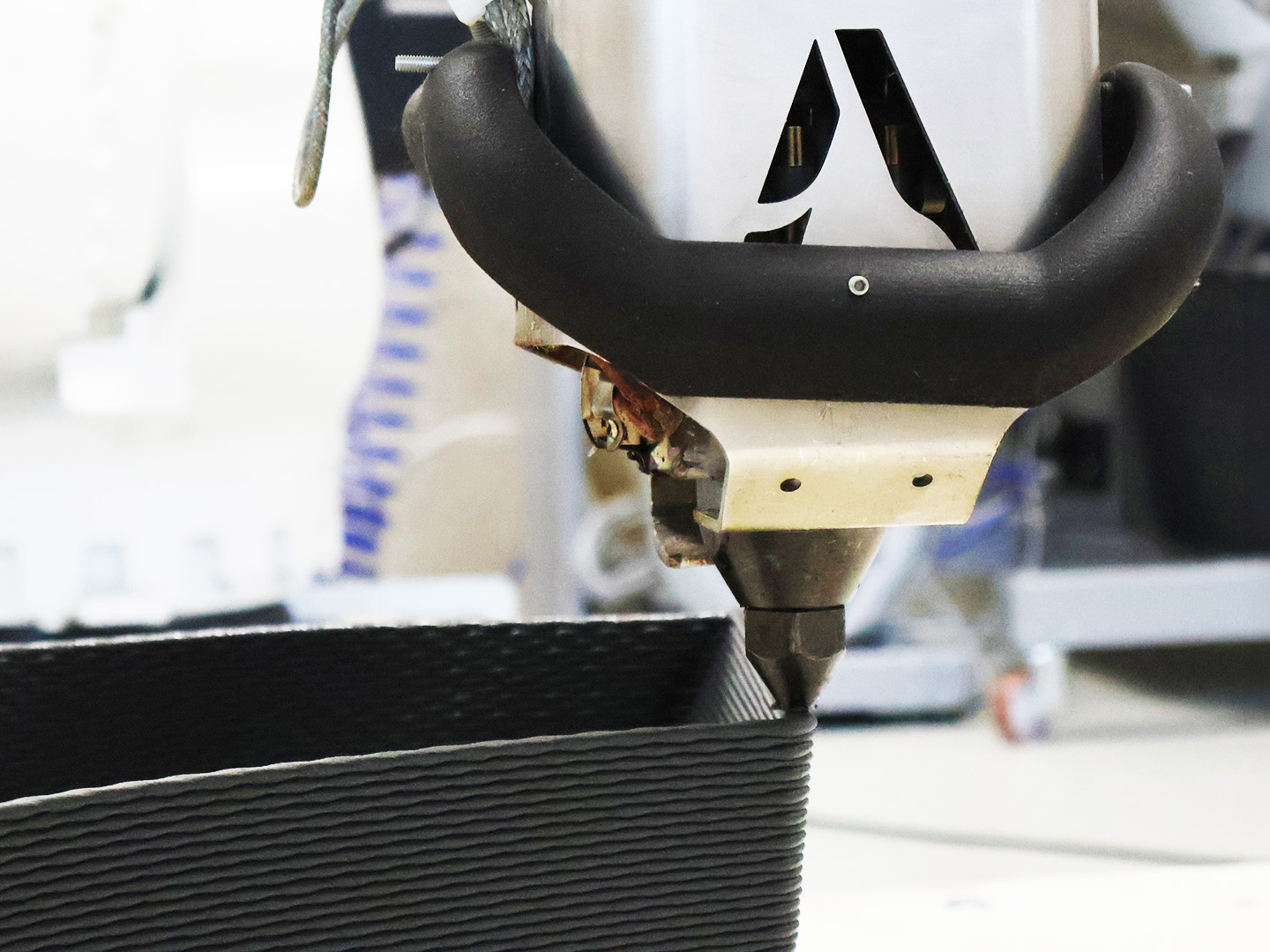
The environmental impact of 3D printing starts with the feedstock
Is 3D printing a waste of plastic? On a hobbyist’s desk, often yes. Failed prints, supports and gadgets nobody needed end up in the bin, and that is the image most critics have in mind. Industrial production works on a different scale and by different rules, starting with the form the material arrives in.
Filament, the feedstock of desktop printers and many professional machines, has already been melted, extruded, cooled and wound onto a spool before it is loaded. Robotic LFAM (large format additive manufacturing) systems feed raw thermoplastic granules directly into a screw extruder, so the material goes through one melting cycle fewer. At industrial deposition rates filament would not even be practical: the 180 kg aerospace tool described below was printed in 19 hours, close to 10 kg an hour, which on 1 kg spools means a change every six minutes.
At these volumes the material bill matters as well. Filament costs at least five times as much as polymer pellets, and researchers at Université de Lorraine printed from pellets for under 1 €/kg, against more than 20 €/kg for commercial recycled filament. Pellets also give access to the full catalogue of injection-molding compounds, including recycled and fiber-reinforced grades. For large parts, the feedstock is probably the single biggest factor in the 3D printing environmental impact, though it rarely gets the attention it deserves.
Is the waste from 3D printing recyclable? With pellets, largely yes, and more easily than with filament. Purge material, rejected parts and machining chips are ground back into granules and fed straight into the extruder, with no extra step to turn them into filament first. Every cycle shortens the fibers, so recycled compound usually moves into less critical parts, but very little of it has to leave the shop.
What makes large-format 3D printing environmentally friendly
Most of the savings in robotic LFAM come from what no longer has to be made. A large part produced conventionally usually needs a master model, a tool, sometimes a multi-piece assembly, or a solid block that gets machined down to shape. Printing near-net shape removes most of those steps, and the effect shows up in three ways:
- Geometric freedom, because material goes only where the loads need it, through ribs, hollow sections and walls that change thickness along the part.
- No tooling. For one-offs and short runs, the mold often weighs more than the parts it will ever make.
- Less post-processing. Only functional surfaces need machining, so there is less swarf to deal with.
Robotic LFAM also starts directly from the CAD file, with no tooling in between, and the robot follows a toolpath generated straight from the model. A designer in Milan, a process engineer in Texas and a customer in Dubai can work on the same digital model, simulate the build and adjust the toolpath before anything is deposited. Since the file is what travels, the part can then be printed wherever there is a robotic LFAM system, without bringing those people to the same place.
The robot itself is a big part of the advantage. A six-axis industrial arm covers volumes of several meters without a huge machine frame, and on rails the working area stretches to around 10 m. With an automatic tool changer, the same arm moves from printing to milling to 3D scanning on the same part, which is where additive turns into advanced manufacturing: one automated workflow that delivers a finished, inspected component.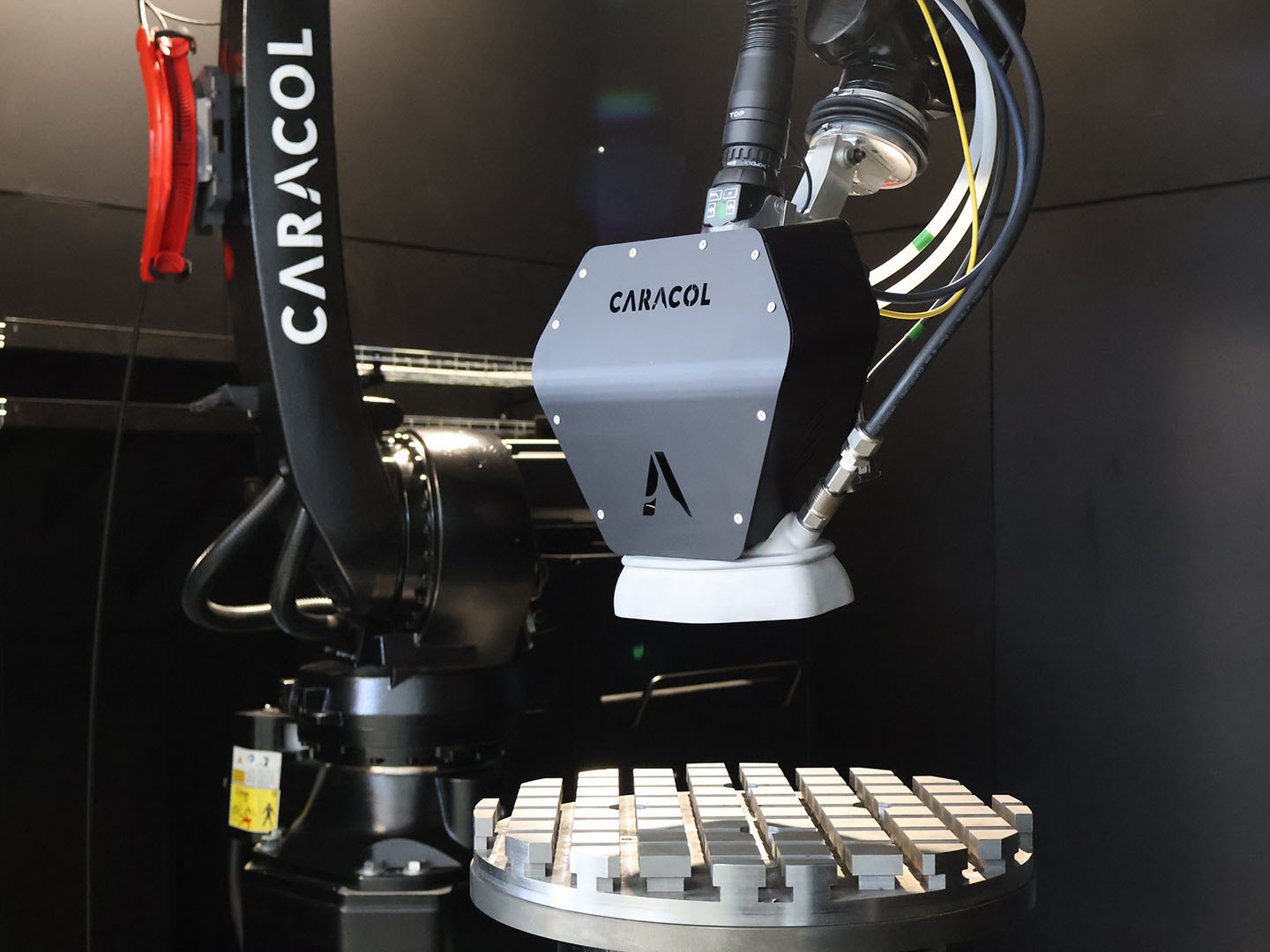
Case studies: how much material robotic LFAM saves
Ferretti Group’s Pershing GTX116 air grilles are a good illustration. Grilles like these are usually hand-laminated in fiberglass over a series of molds. Ferretti printed them on Caracol’s Heron AM robotic platform in glass-fiber ASA and only had to apply gel coat afterwards. The result was 50% shorter lead time, 60% less scrap and 15% lower weight.
In aerospace tooling, Formes et Volumes printed a single-piece lamination tool measuring 2200 × 2200 × 600 mm in 19 hours and then finished it with CNC machining and an autoclave cycle. Compared with conventional tooling, lead time and material waste were both cut in half and cost dropped by 30%.
Cross Industry Dynamics had the opposite constraint, a trade show date that left no room for a mold. The hypercar prototype body took 24 hours of printing, and the whole project, from sketch to show floor, took two weeks.
Metal parts, buy-to-fly and 3D printing sustainability
In metal, engineers talk about the buy-to-fly ratio, the weight of material you buy compared with the weight of the part you end up with. For aircraft structural parts it is commonly around 20:1, so about 19 kg out of every 20 purchased become scrap. Those chips get recycled eventually, but the energy that went into making the billet is gone.
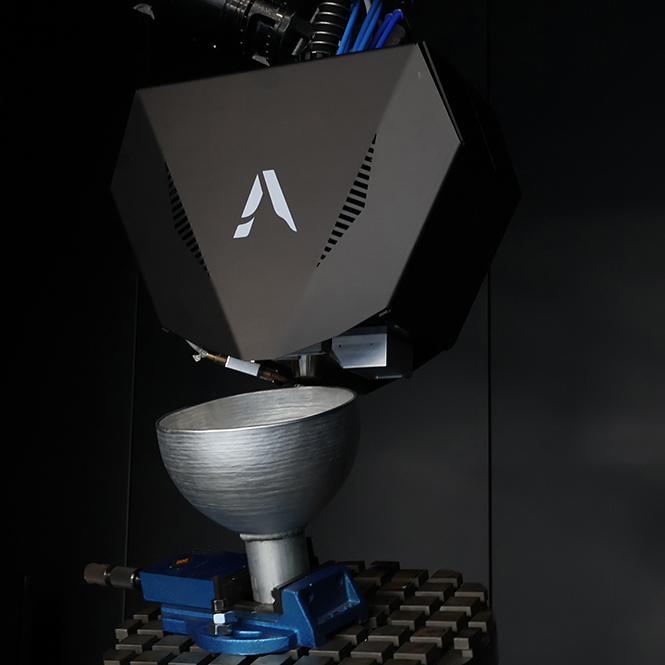
With wire arc additive manufacturing (WAAM), metal is laid down roughly in the shape of the final part, with a small allowance left for machining. Much less material is bought, and much less ends up on the shop floor.
JOME Engineering needed a replacement propeller in Dubai and had no drawings to work from. The team scanned the old part and printed a 26 kg SS316L propeller on Caracol’s Vipra AM, a robotic WAAM platform. Compared with casting, they saved roughly 60% on lead time and 40% on cost, and because no steel die was needed and only the deposited wire was melted, the CO2 footprint was lower too.
The timings deserve attention. Printing took around 20 hours and machining around 100. Anyone budgeting a WAAM project should plan for that, since the robot is rarely where the time goes. It is also a strong argument for robotic cells that print and machine in the same setup.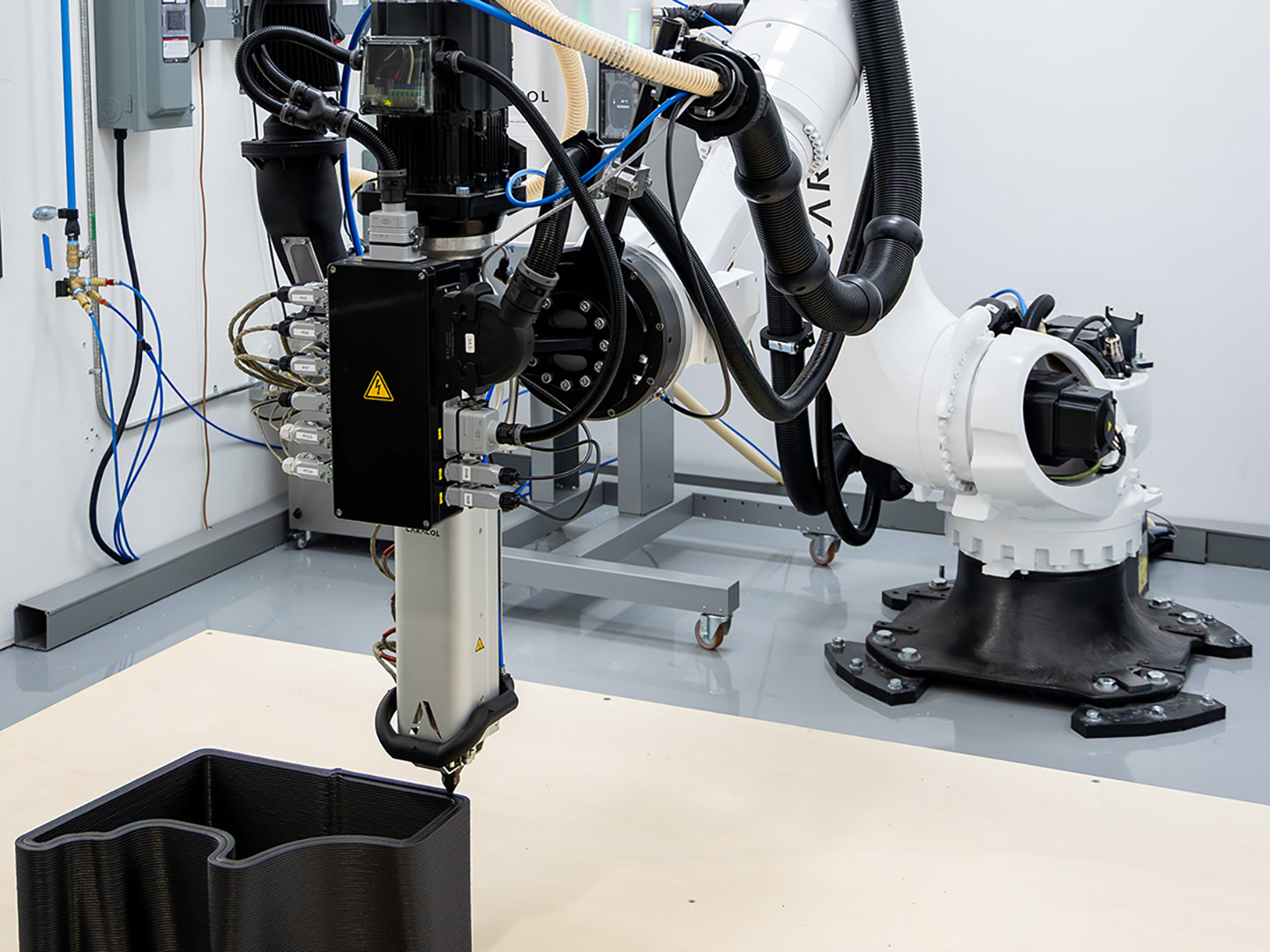
Robotic microfactories: 3D printing and sustainability at the point of use
One point is easy to overlook: manufacturing itself is responsible for only a fraction of a supply chain’s total carbon footprint, while moving parts around accounts for much of the rest. Making parts where they are needed attacks the larger share of the problem.
Caracol approaches this as an advanced manufacturing challenge, where additive is one process among several. Its microfactory is built around that idea, with printing, milling, scanning and inspection inside one robotic cell. The robot changes between extruders, a milling spindle and a scanner, so a part comes out finished without visiting three different suppliers. Cells are set up close to the end user and duplicated when volumes grow. Caracol puts the saving at 20 to 50% on capex versus a centralized plant, and its ecosystem approach treats robots, materials, Eidos Manufacturing software and process expertise as one package qualified together.
Automation is what makes this model work outside a big plant. Inside the cell, sensors follow the process as it runs, tracking bead geometry, temperature and the behavior of the melt pool, while an IoT layer lets one engineer monitor a single robot or a whole fleet from another site. Software and AI do the rest, turning the know-how of a few specialists into process parameters every cell can repeat. Parts are made on demand, close to where they will be used, so warehouses shrink and most of the trucking, shipping and air freight drops out of the picture.
Is 3D printing ethical?
It depends on what it replaces. Swapping a steel die, a 20:1 billet or a container crossing an ocean for a printed part is a measurable improvement. Printing parts that a mold would make more efficiently at high volume, or parts nobody really needs, only moves the problem somewhere else. On-demand production also means less inventory and fewer products that become obsolete on a shelf.
The weak point today is data. Methods for comparing sustainability across technologies are still inconsistent, and most published figures come from individual case studies, including the ones cited here.
For anyone evaluating an additive or wider advanced manufacturing project, a few questions get closer to the truth than any brochure. What is the buy-to-fly ratio? Where does the feedstock come from, and how far will the finished part travel? End of life is the hardest question, especially for fiber-reinforced compounds, and few in the industry have a convincing answer yet.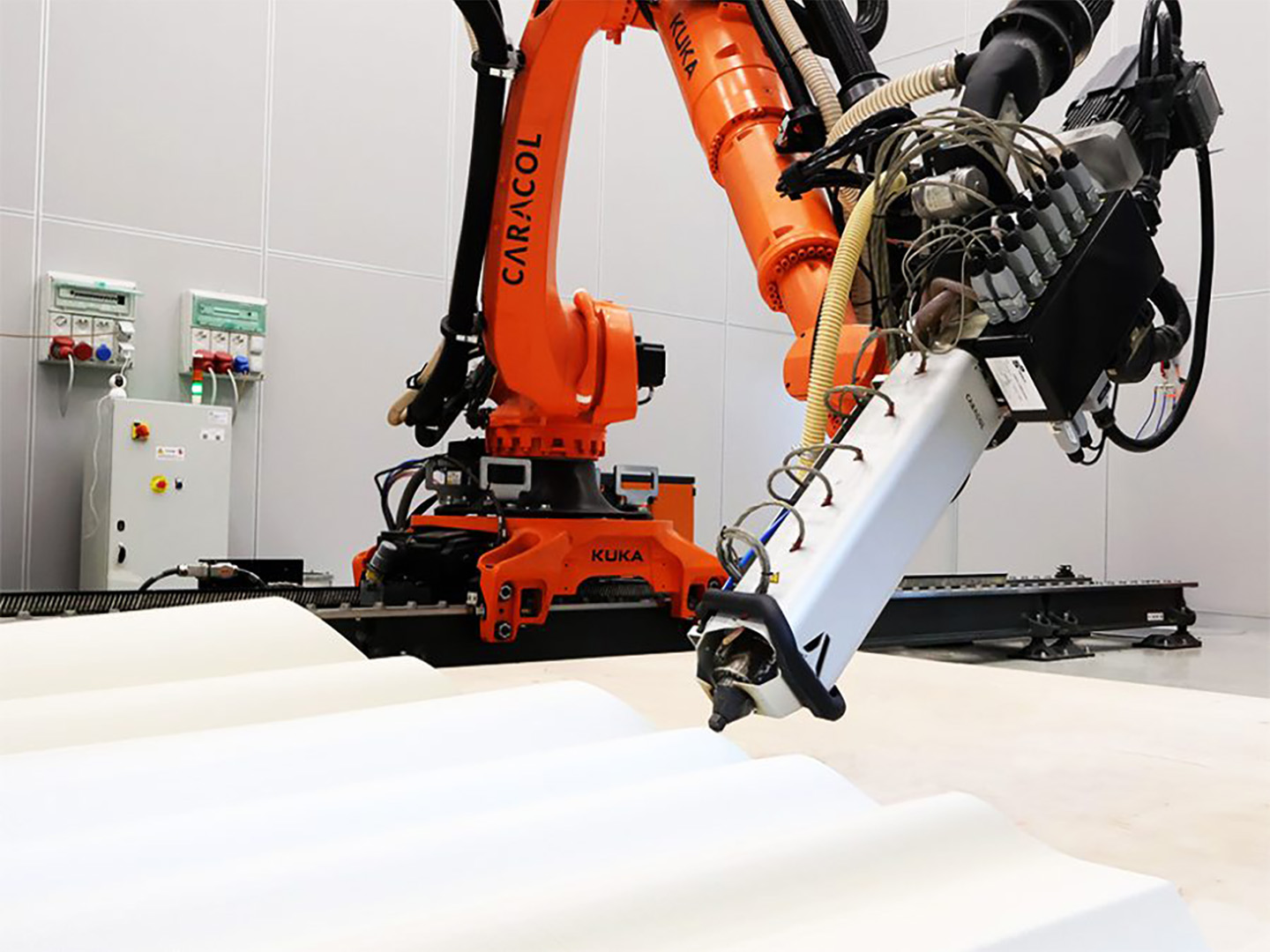
Evaluating robotic LFAM or WAAM for your next project?
LFAM FOR THE AUTOMOTIVE INDUSTRY
Discover how to use Caracol’s large-scale 3D printing technology for your automotive applications. Register here to download the whitepaper.
Articles Knowledge Hub connexes
En savoir plus sur les technologies LFAM
-

Knowledge Hub. Direct Energy Deposition (DED): What It Is and How It Works
-

Knowledge Hub. 3D printing car in additive manufacturing: how the automotive industry is rethinking production
-

Knowledge Hub. Robotic LFAM for end-use parts in the transportation industry
-

Knowledge Hub. What Is Rapid Prototyping in 3D Printing? Methods, Examples, and Where Prototyping Ends
-

Knowledge Hub. Why the advantages of robotics in manufacturing start in the classroom
-

Knowledge Hub. Robotic automation in manufacturing: how industrial robots are reshaping modern production
-

Knowledge Hub. 3D printing in defense: how robotic LFAM and WAAM are redefining industrial dual-use production
-

Knowledge Hub. How to build a robotic LFAM Microfactory – the final tutorial
-

Knowledge Hub. The microfactory model: robotic additive manufacturing for flexible industrial production
-

Knowledge Hub. Metal 3d printing: challenges & scalability
-

Knowledge Hub. Industry 5.0 vs Industry 4.0: key differences and what changes for manufacturing
-

Knowledge Hub. On-demand manufacturing: what it is, how it works, and some examples
-

Knowledge Hub. How is 3d printing used in architecture?
-

Knowledge Hub. Carbon Fiber Composite Manufacturing at Scale: How Robotic LFAM Redefines Composites
-

Knowledge Hub. What 3D Printer Design Software to Use for Large Format Robotic Systems: A Complete Guide
-

Knowledge Hub. 3D Printing in Automotive Manufacturing, Aviation, and Mass Production: How AM Is Reshaping Mobility
-

Knowledge Hub. Best practices for Design & Production with robotic LFAM
-

Knowledge Hub. Integrating robotic process automation (RPA) for strategic growth in modern advanced manufacturing
-

Knowledge Hub. Robotic large format additive production for Jigs & Molds
-

Knowledge Hub. Robotic large format additive production for Marine Applications
-

Knowledge Hub. Robotic large format additive production for the Automotive Industry
-

Knowledge Hub. Robotic additive production for Design & Architecture
-

Knowledge Hub. Applications of 3D Printing in Aerospace and Defense
-

Knowledge Hub. Distributed Manufacturing: Building Resilient, Flexible Supply Chains
-

Knowledge Hub. Metal Additive Manufacturing Market: Technologies & Processes for Demanding Industries
-

Knowledge Hub. Robotics and Automation transform industries: a look into the Future of Manufacturing
-

Knowledge Hub. 3D printing Architectural Elements for Building
-

Knowledge Hub. Empowering industrial production with live data: the growing role of IoT in LFAM
-

Knowledge Hub. How is 3d printing used in the automotive industry?
-

Knowledge Hub. What is Advanced Manufacturing? How technology improves industrial manufacturing
-

Knowledge Hub. Why adopt thermoplastic 3d printing materials for advanced industrial applications
-

Knowledge Hub. Strengths and weaknesses of the 3 most common 3D printing materials
-

Knowledge Hub. Industry 4.0 & additive manufacturing: delivering efficiency and sustainability in production
-

Knowledge Hub. The rise of 3D printed furniture: leveraging LFAM to revolutionize the design industry
-

Knowledge Hub. The future of LFAM: integration at its core
-

Knowledge Hub. The benefits of 3D printing aircraft parts
-

Knowledge Hub. How does 3D printing help the environment?
-

Knowledge Hub. Innovation in the marine industry: 3D printing boat structures and components
-

Knowledge Hub. Pellet 3D printing and its benefits compared to 3D filament extruders
-

Knowledge Hub. Guidelines for large format 3d printing
-

Knowledge Hub. Sustainability in the automotive industry through LFAM
-

Knowledge Hub. What is robotic LFAM 3D printing?
-

Knowledge Hub. Beyond rapid prototyping 3D printing, towards industrial production with LFAM
-

Knowledge Hub. Engineering the future of manufacturing through LFAM