




 Actualités et événements
 Engineering manufacturing beyond Earth: Caracol and ESA develop AI-based LFAM for space

février 2026
Engineering manufacturing beyond Earth: Caracol and ESA develop AI-based LFAM for space
février 2026

With the AIMIS-LFAM project, Caracol and the European Space Agency explore how artificial intelligence and robotic LFAM can enable autonomous manufacturing in orbit, unlocking a new era for space infrastructure.
The future of space exploration is no longer limited to launching fully assembled structures from Earth. As missions grow in scale and complexity, the ability to manufacture directly in orbit is emerging as a strategic game changer. Producing large structures – such as trusses, solar array supports, and deployable systems – directly in space allows engineers to overcome launch constraints, reduce mass, and unlock design solutions that would be impossible to transport from Earth.
This vision lies at the core of the AIMIS-LFAM project (AI-Based Monitoring of Large Robotic Format Additive Manufacturing in Space), developed under the European Space Agency – Technology Development & De-Risking program. As Prime Contractor, Caracol led the initiative, coordinating a consortium that also included Politecnico di Milano and OBO Space, reinforcing its position as one of Europe’s most advanced players in robotic large-format additive manufacturing. The nine-month project directly supports ESA strategic frameworks such as the Technology Vision 2040 and the SOLARIS initiative, which promote sustainable, autonomous, and resilient space infrastructure.
From terrestrial LFAM to autonomous manufacturing in orbit
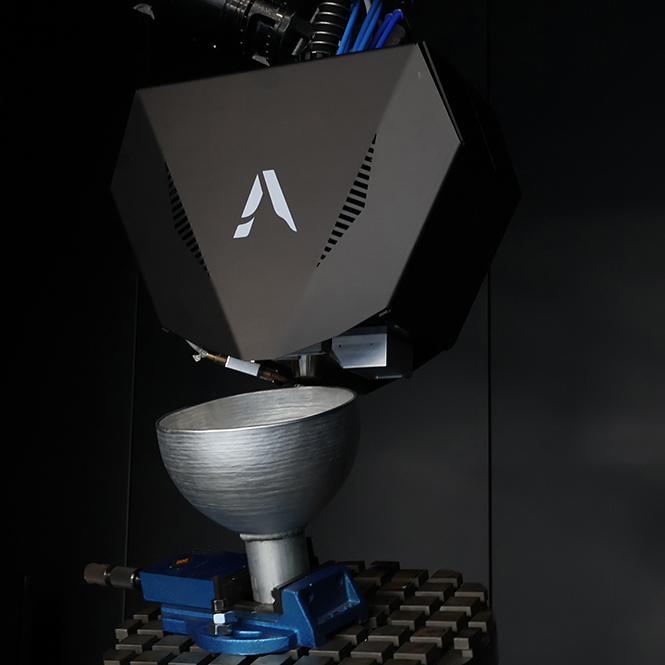
Manufacturing in space is fundamentally different from manufacturing on Earth. Microgravity, vacuum, extreme temperature gradients, and radiation can significantly affect material behavior and process stability. At the same time, human supervision is limited or entirely absent, making traditional quality control approaches impractical. For robotic LFAM to become a viable solution for in-space applications, the process must be autonomous, intelligent, and self-aware; capable of monitoring itself, detecting defects, and ensuring reliability in real time. Leveraging its deep expertise in robotic extrusion, LFAM, and advanced manufacturing systems, Caracol developed an AI-driven, multi-sensor monitoring architecture specifically designed for its large-scale robotic 3D printing technology, Heron AM.
Within the AIMIS-LFAM project, visible and infrared sensors were integrated into Heron AM to capture both geometric and thermal data during the printing process. These data streams were then processed using artificial intelligence algorithms trained to identify anomalies such as thermal instabilities and material irregularities during material deposition. Politecnico di Milano contributed its scientific expertise in data analysis, artificial intelligence, and process modelling, supporting the development of advanced monitoring algorithms and data fusion strategies. OBO Space complemented the consortium with its aerospace engineering know-how, providing insight into space environment constraints, system integration, and mission-oriented requirements.
On-Earth experimental trials demonstrated that combining multi-sensor data with AI-based analysis enables early and accurate defect detection, significantly improving process stability. Over the project duration, the monitoring system was successfully advanced from TRL 2 to TRL 3. In parallel, a structured Development Plan was defined to guide future activities toward TRL 4–6, through extended testing and prototype demonstration in representative environments.
From technology validation to orbital manufacturing
AIMIS-LFAM confirms that AI-enabled monitoring is a key enabler for autonomous manufacturing in space: by combining advanced artificial intelligence with Heron AM, Caracol has demonstrated outstanding system integration capabilities and deep process expertise, delivering a robust foundation for reliable in-space LFAM. The project aligns with ESA’s long-term vision for sustainable and self-reliant space infrastructure, opening the door to future applications such as space-based solar power systems, large deployable structures, and orbital manufacturing platforms.
Building on these results, Caracol is uniquely positioned to lead the next generation of in-space manufacturing projects. Future developments will focus on advancing Heron AM toward higher Technology Readiness Levels, with prototype validation in vacuum and microgravity environments and the expansion toward full-scale autonomous orbital manufacturing. With AIMIS-LFAM, Caracol is not simply adapting manufacturing for space, it is defining how large structures will be built directly in orbit, shaping the industrial future of space.
This activity was carried out under a programme of, and funded by, the European Space Agency (ESA). The views expressed herein can in no way be taken to reflect the official opinion of the European Space Agency.
LFAM FOR THE AUTOMOTIVE INDUSTRY
Discover how to use Caracol’s large-scale 3D printing technology for your automotive applications. Register here to download the whitepaper.
Actualités connexes
Découvrez nos dernières actualités et événements
-

Actualités et événements. Freeman Boatworks selects Caracol to implement robotic large-format additive manufacturing across their production operations.
-

Actualités et événements. JEC World 2026: unlock your next composite applications for the transportation industry
-

Actualités et événements. RIGENER-AM: Turning Industrial Waste into High-Performance Materials for Additive Manufacturing
-

Actualités et événements. A Decade of Innovation – Build What’s Next
-

Actualités et événements. Caracol Raises $40M Series B to Accelerate Global Scale-Up of Advanced Manufacturing
-

Actualités et événements. Caracol and RusselSmith Sign an exclusive Partnership to Drive Advanced Manufacturing in West Africa
-

Actualités et événements. Caracol acquires Weber’s AM assets to expand LFAM leadership in Europe
-

Actualités et événements. Caracol Secures ESA Grant to Lead Space-Focused Additive Manufacturing Project
-

Actualités et événements. Caracol and CNC Robotics forge strategic partnership to empower UK manufacturing
-

Actualités et événements. Caracol’s robotic LFAM technology powers “PORTAL” at Milan Design Week 2025
-

Actualités et événements. Rapid + TCT 2025: transform your production with robotics LFAM made in USA
-

Actualités et événements. JEC World 2025: discover Caracol’s latest innovations for robotic LFAM of composite materials
-

Actualités et événements. Reimagining manufacturing at Dubai Design Week
-

Actualités et événements. Build the Unbuildable – LFAM goes Beyond at Formnext 2024
-

Actualités et événements. Caracol doubles down on IMTS 2024 in Chicago
-

Actualités et événements. Caracol at RAPID+TCT 2024
-

Actualités et événements. JEC WORLD: Large format 3D priting for the composite industry
-

Actualités et événements. LFAM companies gather to discuss further expansions of a growing market segment
-

Actualités et événements. LFAM boosting the marine industry: METS TRADE 2023
-

Actualités et événements. Evolving Additive Manufacturing at Formnext 2023
-

Actualités et événements. Caracol and Mobilita join forces for the post-graduate on Robotics, Mechatronics and Additive Manufacturing
-

Actualités et événements. Caracol develops smart 3D printing systems for large-scale components
-

Actualités et événements. Caracol joins 30 partners for the European DeremCo project
-

Actualités et événements. Exciting shows in Paris and Chicago to see the LFAM system Heron AM
-

Actualités et événements. Caracol acquires Stratasys Fortus technology
-

Actualités et événements. Caracol closes €10.6 million Series A and launches internationalization
-

Actualités et événements. The growing adoption of LFAM meets consensus at AMS
-

Actualités et événements. Caracol at Formnext 2022
-

Actualités et événements. Caracol partners with OVERMACH ADDITIVE to promote LFAM in Italy
-

Actualités et événements. The Evolution of Caracol
-

Actualités et événements. Caracol first company in Italy to obtain AS/EN 9100 certification to produce Aerospace parts with its LFAM process
-

Actualités et événements. Caracol at Isola Digital District 2020
-

Actualités et événements. 3D Printed Masks Donated to Institutions across Italy